【导读】锂动力
电池组是电动汽车的核心部件,而均衡电池单元也是电池管理系统设计的一大挑战。如果设计不过关,那么你的纯电动汽车在充电时就有可能会爆炸。如果不能确保动力电池的可靠性,再便宜消费者也不会买单。怎样才能解决这一问题呢?飞思卡尔动力电池组的主动均衡技术和方案实现将很好地解答你的疑惑…
Batteries made of multiple cells connected in series are often used as a power source for common electronic devices. In multicell battery chains, small differences between the cells (due to production tolerances or operating conditions) tend to be magnified with each charge or discharge cycle. In these situations, weaker cells are overstressed during charging, causing them to become even weaker, until they eventually fail and cause a premature failure of the whole battery. Cell balancing is a way of compensating for these weaker cells by equalizing the charge on all the cells in the chain, thus extending the battery life.
The life of a rechargeable battery can be extended through the use of an intelligent charging system. The charging system must incorporate the proper charging method for the appropriate battery type (according to the battery chemistry) and overcharge protection to preven battery damage. These circuits can be implemented in the charger or in the battery.
Similar to the charging state, discharge control has to be implemented in the application or in the battery.One of the prime functions of this system is to provide the necessary monitoring and control to protect the cells from situations outside of normal operating conditions.
2 Balancing methods
There are two main methods for battery cell charge balancing: passive and active balancing.
The natural method of passive balancing a string of cells in series can be used only for lead-acid and nickel-based batteries. These types of batteries can be brought into light overcharge conditions without permanent cell damage. When the overcharge is small, the excess energy is released by increasing the cell body temperature. The excess energy can be released by the external circuit connection in parallel to each cell. This circuit consists of a power resistor connected in series with a control MOSFET transistor. This method can be used for all types of batteries, but is effective for a small number of cells in series.
The active balancing method is based on the active transport of the energy among the cells. This balancing method does not depend on the chemical characteristics of the cells, and can be used for most types of modern batteries. There are several types of active balancing methods based on the type of energy transfer.The energy transfer can be from one cell to the whole battery, from the whole battery to one cell, or from cell to cell. Each energy transfer is based on the type of dedicated DC-to-DC converter. The energy is transferred from the strongest cell to the whole battery or other cells, and from the battery or other cells to the weakest cell.
[page]
3 Selected solution
Each type of DC-to-DC converter used has its own characteristics. The final decision depends mainly on the electrical power sourced from the battery, on the battery capacity in ampere-hours (Ah), and on the final application requirements.
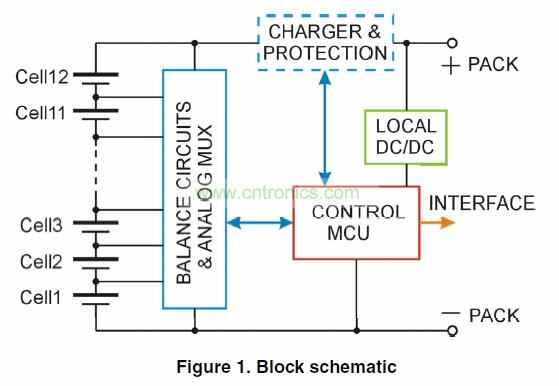
This example uses a charge transfer between individual cells. The block schematic is shown in Figure 1.

 新品速递